
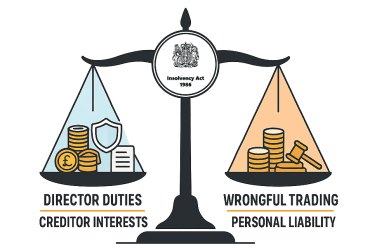
Wrongful Trading – Director Liability & How to Avoid It
Wrongful trading is where an insolvent company has continued to trade in a way which worsens the position of the creditors that any reasonable director would not have allowed.
Read Wrongful Trading – Director Liability & How to Avoid It
Wrongful trading is where an insolvent company has continued to trade in a way which worsens the position of the creditors that any reasonable director would not have allowed.
Read
Company Debt Advice
If your company is struggling due to business debt, then we can give advice about how you can reduce it.
ReadWill I Go Bankrupt If I Am A Director Of A Company That Goes Bust?
The content on this page has been written by Robert Moore and approved by Chris Ferguson Licensed Insolvency Practitioner and Managing Director of RMT KSA
Read
UK SME companies run by women are less likely to go bust than companies run by men.
UK SME companies run by women are less likely to go insolvent than companies run by men. KSA Group Limited, insolvency practitioners who run the website www.companyrescue.co.uk has researched the UK SME market of over 4m businesses in an attempt to see if there was a gender bias on the board of companies that become insolvent. The study was designed to investigate if the insolvency rate was higher for male or female-run companies. In this follow up to its 2018 Study of its kind in the UK, companies were investigated to determine the gender of the board of companies that had either gone into administration or liquidation over the last twelve months, to see if there was any correlation between gender and the general financial health of a business. Key findings Insolvency rate is 71% higher in male run companies 9 times as many companies are run by men than women There is a small difference in the industry sectors of companies run by men or run by women. Construction businesses more likely to be male run and education business more likely to be run by women. It was found that the insolvency rate of male-dominated businesses was 0.7% and those in female-dominated businesses was 0.41%. So, the insolvency rate is 71% higher in male-run businesses. What conclusions can we draw from these findings? KSA Group said; “It is apparent that the insolvency rate is higher in male run businesses, but this may be due to a number of factors that have nothing to do with whether men are inherently worse at running businesses than women. It may well be that the businesses that tend to be more likely to become insolvent due to the nature of the industry or recent economic events are coincidently run by men.” However, he went on to add that "This is now the third study that we have carried out since 2018 and the results are very similar. In 2018 the types of businesses run by women were different to the ones in 2024. In 2018 property businesses made up a higher proportion of women run businesses that went into insolvency whereas in 2024 it was Retail and Education. This might suggest that the business sector is not that relevant and so pointing to a higher financial competency, or less risk taking, by women directors. Women in the Insolvency Profession On average, 15% of Licensed Insolvency Practitioners (IPs) are women which does mirror the number of women run businesses. One outlier firm is Alvarez and Marsal Europe LLP with 27% of their IPs being women. See the pie charts below which have categorised businesses into the established Standard Industry Classification.
ReadCan I Sell My Company’s Assets Prior To A liquidation
Yes you can sell or transfer assets prior to insolvency but you must make sure that the assets are valued correctly and a fair price is paid. Otherwise you run the risk of the transaction being reversed by the liquidator.
ReadHow Can I Legally Take Money Out Of My Limited Company?
When you set up your limited company, you may think you can dip into your company’s monies, as and when you like, as it is your cash! Unfortunately, this approach is wrong and can often lead to financial problems for directors of troubled companies.
Read
Company Insolvency in Scotland
Is there a genuine company rescue culture in Scotland? There is only one company driving the rescue culture in Scotland, and you have found it! Our firm RMT KSA, who run this website, are responsible for a significant proportion of CVA led rescue work in Scotland. If you run an insolvent or struggling Scottish company the chance of rescue is low. Amazingly, less than 1% of insolvent companies are rescued by a company voluntary arrangement or CVA each year! This is compared to England and Wales, where proportionally, the CVA is used 4 times as often. So always ask your advisors these questions - What about a CVA - would that work? What is the comparison between CVA and liquidation? What is the comparison between CVA and administration?
ReadDirector Liability for Company Debt: A Guide to Personal Risk
Generally, a director is not liable for their company's debts unless they have acted fraudulently or wrongfully. This is what limited liability means in the context of an incorporated company.
ReadCan I Claim Directors Redundancy in Liquidation?
When a company goes into administration or liquidation the directors of the business are in effect made redundant. Their powers and duties as directors cease. So, it isn't surprising to know that directors are in fact entitled to redundancy payments if they were employed by the company. Given the company is insolvent then it cannot afford to make the payments, so instead the bill is picked up by the Redundancy Payments Office (RPO). This fact can help alleviate some directors concerns about liquidation. In any liquidation the employees are able to claim for arrears of Wages, accrued Holiday Pay and Pay in Lieu of Notice, and if they have been working for the same employer for two consecutive years are also entitled to receive a statutory Redundancy Payment. The same applies to directors. There are a number of companies out there claiming they can get large payments for directors but there are a number of caveats. What are the eligibility criteria? You must have been employed by the company and received a wage commensurate with your work. This is not often the case as directors usually pay themselves with dividends and take a minimum wage for tax reasons. This was actually one of the reasons why many didn't benefit from furlough payments during the pandemic as they were not actually employees. You must have proof you were employed. Again just being paid via PAYE may not be enough. You will need to show that you had a contract and that terms were set (these can be implied and not necessarily detailed in an employment contract) example terms might be holidays taken, sick leave, paternity.maternity payments, car allowances, pension provision etc. ie all the usual things that an employee has. An employee may not work less than minimum wage. This is important as if you are putting in long hours and not being paid much then it actually means you are not an employee! As such any claim will not be accepted. Small monthly payments will just be seen as extracting money from the company as an office holder not an employee. How do I apply? Once the company has gone into liquidation or administration then there is an application form that the directors can fill in. It doesn't take long and there really isn't any need to employ a third party to do the claim for you. Some companies are making some misleading claims about average payouts etc. How much am I likely to get paid? You will receive redundancy and loss of pay if you are entitled to it. However, in most cases that we have dealt with the directors owe the company money and this negates any payout that is likely to be owed. In addition, the Redundancy Payments Office (RPO) is getting very strict about claims, so a director that has taken out substantial dividends is unlikely to be regarded as an employee. The amount is capped at £719 per week.
Read
Company Cash Flow Problems: Solutions For Worried Directors
Many companies are likely to experience cash flow problems at some point. This is usually due to late payments by customers or unexpected costs. The best way to solve this is to have good financial controls. If that is not possible then there are options.
ReadOverdrawn Director’s Loan Accounts in Insolvency
An overdrawn director's loan account is created when the director takes money out of the company, by the form of a loan, resulting in the director owing the company money. When the amount extracted is more than what can be put back in, the account is overdrawn.
Read
Directors Duties in Insolvency
Know the duties of directors in companies. These duties can change once the business is insolvent. In law, if a company is insolvent then the directors have a duty to the creditors not themselves or the shareholders.
Read