
Refrigeration Engineering Company Suffered Decline In Market
Refrigeration Engineering Company Suffered Decline In MarketManufacturing and Engineering

Read How We Rescued Manufacturing And Engineering Firms Below
Every business is different, however there are particular issues that manufacturers face which are unique to the sector.
Trading conditions can be difficult and there is often tough competition. Problems include:
- Profit margins
- Foreign price wars
- Sales targets
- Difficult market conditions resulting in low pricing
- Unusual working shift patterns
- Tough competition from the UK and overseas
- Quality versus price
- Tier one or two suppliers exerting price pressure downwards
- Lack of skilled engineers
- Factories not working to capacity
As turnaround practitioners, our specialists can help tackle these issues with you to get your manufacturing or engineering business back on track. We can go through all the available options, like expert assessment of the issues your company faces, improved financial reporting, Time to Pay deals, CVAs and pre-pack administrations.
We have many years of experience turning around manufacturing and engineering companies, why not give us a call and see how we can help?
RMT recently saw a group of engineering companies in the southwest which was facing winding up actions by HMRC for non payment of tax debts. We organised removal of most of the secured debt, met with the secured banks, found alternative funding offers of £3m (exiting banks decided to continue to work with the companies, though) and led a complex restructure. We met the main CUSTOMERS and SUPPLIERS and showed these stakeholders turnaround plans.
Case Study 1 – €48m FMCG Manufacturer Distributor Hit By Withdrawal of Banking Services
The Challenge
A multinational group of three companies, headquartered in the UK with operations across five EU countries, faced a sudden and severe financial crisis. The group, which supplied wholesalers and retailers and had sales of around €13 million, was thrown into disarray after its international bank surprisingly and sharply reduced its working capital facilities. This caused an immediate collapse in the group’s ability to place orders. The timing was catastrophic, as this occurred just after the main buying season, leaving the business without the trade and stock finance needed for the upcoming Christmas 2018 and Spring 2019 seasons. With unsecured liabilities of €7.2 million and a secured debt of around €4 million, the directors needed a comprehensive restructuring to save the business.
The Solution
The directors appointed RMT to oversee a complete restructure of the group. The core of the strategy was a Company Voluntary Arrangement (CVA), which was used to restructure the unsecured debt. RMT experts guided the company through a “right-sizing” of the group, which included a reduction in costs and the departure of 16 people, including the CEO. This left a smaller, leaner, and more efficient business. As part of the CVA strategy, RMT also helped the company to exit its head office, which resulted in a significant annual saving of approximately £200,000. RMT managed the complex negotiations with the landlords of the two main warehouses, ensuring that rent payments were maintained to release a backlog of €4 million worth of stock, over which liens had been or were about to be exercised. This generated crucial liquidity for the business.
The Results
With the CVA successfully implemented, the company’s sales were re-focused on more manageable levels. The huge annual need for debt facilities was eliminated, and the company was no longer burdened by the low-margin, high-volume FMCG products that required it. With sales now at around €13 million and costs significantly reduced, the business was projected to generate profits of €450,000 in the first CVA year, rising to €800,000 in 2019-2020. The CVA also allowed the company to manage customer expectations, with RMT helping to explain the strategy to large retail groups. This case demonstrates that a CVA can be a powerful tool for a multinational group to restructure its debts and operations, even when faced with a sudden loss of funding, and can put the business back on a path to profitability.
Case Study 2 Manufacturing Company Facing A Loss Of A Contract
The Challenge
An Essex-based company, incorporated in 2007, was facing significant financial difficulties due to legacy debts. The business had suffered from a downturn in trading activity, a fall in turnover to £336,000, and the loss of a vital contract. As a result, its debts to both HMRC and trade creditors had grown to an unmanageable level. The total unsecured debt stood at £192,125, with HMRC owed a substantial £133,625, representing approximately 70% of the total. The directors had identified the problem and sought professional insolvency advice to deal with the severe cash flow pressures and prevent a forced liquidation.
The Solution
One of the directors contacted RMT, who was appointed on December 5, 2012, to assist with a Company Voluntary Arrangement (CVA). Prior to RMT’s appointment, the company had already taken proactive steps to mitigate its problems by replacing the lost contract with another and making one redundancy to reduce overheads. The CVA was proposed as the ideal mechanism to provide a formal, legal framework for the business to restructure its debts and continue trading. The CVA proposal offered a dividend of 41p in the £1 to be paid to the unsecured creditors. This plan was designed to be a viable alternative to liquidation, providing a better return for creditors while saving the business.
The Results
The CVA was a complete success. HMRC, which held the majority of the unsecured debt, approved the CVA with standard modifications on July 2, 2013. The CVA was then formally approved by the entire body of creditors at a meeting held on July 16, 2013. The CVA’s approval was a critical milestone, as it allowed the company to avoid liquidation and continue its operations. The successful restructuring saved 7 jobs, which would have been lost had the company been wound up. The outcome demonstrates that a CVA can be a powerful tool for a company with a viable business model to overcome legacy debt and cash flow issues, providing a clear path to recovery and long-term stability.
Other Rescue Stories
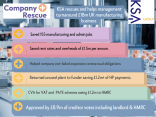
£18m T/o Pharmaceutical Manufacturing Company
£18m T/o Pharmaceutical Manufacturing Company
Civil Engineering Company Loses Major Contracts
Civil Engineering Company Loses Major Contracts