
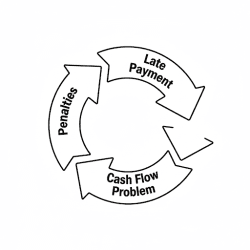
Penalties for Late Payment of PAYE
HMRC implement penalties for late payment of periodic PAYE /NIC from businesses.
ReadPenalties for Late Payment of PAYE
HMRC implement penalties for late payment of periodic PAYE /NIC from businesses.
Read
Directors Duties in Insolvency
Know the duties of directors in companies. These duties can change once the business is insolvent. In law, if a company is insolvent then the directors have a duty to the creditors not themselves or the shareholders.
ReadI am a director of a limited company – Can my personal assets be seized?
The content on this page has been written by Robert Moore and approved by Chris Ferguson Licensed Insolvency Practitioner and Managing Director of RMT KSA
ReadWhat is a Validation Order?
A validation order is where a company can apply to 'unfreeze' the company's bank account. This is a court order that essentially "validates" transactions going through the account and prevents a liquidator from holding the bank liable for money being withdrawn, whilst there is a winding up petition.
ReadWhat is the effect of a winding up petition on a football club?
Firstly...what does 'being served a winding up petition' mean? If a company or football club has been served a winding up petition then it usually means that all previous attempts at settling the debt have been unsuccessful. As such the creditor uses the "nuclear option" whereby they say that the club has to be wound up as it simply cannot pay its debts. An application, or petition, is made to the High Court (this is the winding up petition) to ask the court to wind the company up. Southend United were the latest to feel this action. And the process? An application is made to the high court to ask the court to wind the company up.20-75 days after the petition has been sent to the company and a hearing is arranged in the High Court or Court of Session in Scotland, for the Court to consider whether it should put the company into compulsory liquidation or not.Note, the winding up petition has to be advertised more than 7 days before the hearing. This puts the process in the public eye and gives a very public indication that the club has not paid some of its debts. As expected, this makes everyone worry about the future of the club. Will the players be paid? Will the club continue to play? Will it be deducted points?For most businesses once a winding up petition has been advertised the business is in effect paralysed as the bank will freeze the account in order to avoid any "disposition of assets". Football clubs are not run purely for profit but also for pleasure by their (usually) wealthy owners. As such, the freezing of the bank account of the club does not usually mean that the club has to shut immediately. Money is often forthcoming from other sources connected to the owners. Of course, it is also not unusual for the monies outstanding to be paid personally by the owners to avoid administration. The personal circumstances of the owners are often complex and there are other companies that are involved in the actual running of the club. As such the effect of a winding up petition does not necessarily mean the end of the football club.But the petition pressure and director being worried about wrongful trading can lead to a situation whereby insolvency proceedings are taken by the directors. This usually involves placing the company into administration. The company must then enter a CVA to exit administration usually with a new owner or funder so it can regain its licence to play in the Football League, Premier League or the Scottish equivalents. The club will be deducted at least 12 points.If the CVA is rejected, as happened before in the case of Leeds United when the administrator sells to a new buyer, then a further points deduction is made - often 15 points. This led to two relegations for Leeds.Interestingly the CVA must pay the football creditors (players and leagues) 100p in £1 BEFORE any creditors like HMRC! Otherwise the CVA is not valid and further points can be deducted or the licence to play in the relevant league withdrawn the ultimate sanction. Given that HMRC are now preferential there is unlikely to be any payments for other creditors. HMRCs Involvement In the football world it is usually HMRC who serve the petitions as it is the main creditorWhat is more, with the level of players wages, the total PAYE liability of the club is usually very high. Any delay in the payments of these amounts over the HMRC does give the club a cashflow boost. Updates At the most recent Owners’ and Executives’ Conference and AGM, a number of new rules were decided regarding the insolvency process and football clubs. The League’s Insolvency Policy has been changed to include the following:Football clubs are no longer required to enter a company voluntary arrangement (CVA) 12 points deduction for a club going into administration (up from 10 points) Continuing to support the Football Creditors Rule whereby football debt is paid before any other creditor (like HMRC). Administrators must have 21 days at least to market a football club that’s in administration, and meet the club’s supporters’ trust to allow them to put forward a bid. Buyers of football clubs (in administration) must pay back creditors a minimum of 35p in the pound over three years (or 25p if transferred by shares). If this isn’t followed, there will be a 15 point deduction the next season. If an individual buys a club with 10% shareholding or more, he/she must inform the Football League.The League wants to focus on strengthening their insolvency policy to make it fair to employees, supporters and creditors.A possible downside to the 21 days rule could be the club is on the market for a considerable amount of time. This could cause the business to lose value over time if suppliers and customers lose faith.
Read
Football Creditors Rule
If a football club in the League faces an insolvency process such as a winding up petition, the directors may take action to protect themselves and place the company into administration. Given that in law, administration is generally a temporary state, there must be an exit - either by way of a sale of the equity (its shares) or business assets to a new buyer, or by way of a CVA.
Read
Director’s Credit Rating After Liquidation: What You Need to Know
The content on this page has been written by Eric Walls and approved by Chris Ferguson Licensed Insolvency Practitioner and Managing Director of RMT KSA
ReadCan’t Afford To Make Redundancies – Worried Directors Guide
You may need to make redundancies but cannot afford it. However, if using a CVA any redundancy costs are picked up by the Government
ReadWhat Is A Transaction At An Undervalue?
A transaction at an undervalue is when an asset is transferred for no payment or sold at below their true value. The transaction becomes a problem if the company is insolvent, as any transfer at an undervalue is in effect depriving the creditors of money owed to them. This is outlined in s238 of The Insolvency Act 1986.
ReadWhat is Special Administration?
When attempting to address major debts, a company may choose to enter administration in order to manage the path out of insolvency. It's a process that falls under the Insolvency Act 1986, during which creditors cannot take action against the company.However sometimes when a very large or important organisation is facing insolvency people talk about a process called "Special Administration" What exactly is special administration? The process, like ordinary administration, entails handing over control to administrators who will take steps to turn a company's situation around if possible - or to wind it down in the most efficient manner.A special administration, on the other hand, requires that client assets be recovered as soon as possible.It also necessitates interaction with market regulators, which could be the Financial Conduct Authority or the Bank of England in the case of a financial firm, or Ofgem in the energy sector.Importantly, special administration is a court-ordered action rather than one reached collaboratively by company directors and insolvency practitioners. What is the purpose of a special administration? This is a sector-specific response.In the energy sector, the recent placement of energy firm Bulb into special administration reflected not only the organization's size in terms of its multi-million-person customer base, but also the national necessity of the energy it supplies. When it comes to the financial sector and investment banks, the rise of special administration was precipitated by the failure of Lehman Brothers. Without a special administration, the economic impact of an investment bank's failure could be even more damaging to the overall economy, necessitating the court-ordered process. If Royal Mail went into special administration, it would be to make sure that letters and essential items were delivered in a timely manner during any turnaround. It would most likely be governed by what is called the Postal Act. Large healthcare providers would also be subject to any special administration due to the potential impact on ill people.As special administration has the potential to involve the highest levels of government then the procedure tends to be lengthy.Administrators will prepare plans within ten weeks of the special administration order, and they will consult with creditors, clients, and the relevant authorities.After a successful court application, the special administration can be completed. It should be noted that it could also be suspended if a company voluntary arrangement is implemented.
ReadCan HMRC Take My House For Failing To Pay Company Taxes?
The content on this page has been written by Keith Steven and approved by Chris Ferguson Licensed Insolvency Practitioner and Managing Director of RMT KSA
Read
Why Directors Delay Getting Advice
There are many reasons why directors don’t act when they are worried about something. Here are a few possibilities: Avoidance: When you are worried about something, it can be tempting to avoid it altogether rather than confront it. Procrastination can be a way of putting off dealing with the problem or issue, in the hope that it will go away or resolve itself. Fear of failure: If you are worried about your business failing or not meeting expectations, you might put off taking advice because you are afraid of facing that failure. By not starting the task, you can avoid the possibility of failing and feeling bad about yourself. Being Overwhelmed: When directors are worried, they may feel overwhelmed by the task at hand. Procrastination can be a way of avoiding the feelings of stress or anxiety that come with tackling a difficult or complex task. Perfectionism: Some people may not take advice or delay doing so, because they have high standards for themselves and are worried about not being able to meet those standards. This can lead to a sense of paralysis, where they are unable to start the task because they are worried about not doing it perfectly. Overall, delaying action or not taking advice is a common coping mechanism for dealing with worry and stress. However, it often makes the problem worse in the long run, as the task or issue continues to loom and causes more stress and anxiety. It's important to recognize the reasons behind the business problems and work to address them in order to move forward and tackle the issue at hand. This is something we can help you do! Call us on 0800 9700539 what have you got to lose!
Read