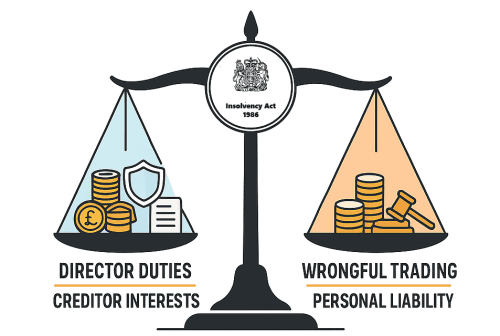
Directors concerned about insolvency should understand wrongful trading and its consequences. Such trading can have severe consequences for your business, your reputation and even your personal life.
The Insolvency Act of 1986 introduced wrongful trading to build on the notion of fraudulent trading. It’s a much more common offence, as it’s not a criminal act and often done unwittingly.
A more technical explanation can be found in Section 214 of the Insolvency Act 1986
It is important to understand if your company enters insolvency or you are worried that your company currently is insolvent! Understand these tests for insolvency
What is Wrongful Trading?
Wrongful trading occurs when company directors have continued to trade when they knew, or ought to have concluded that there was no reasonable prospect of avoiding insolvency. In addition, they did not take every step with a view to minimising the potential loss to the company’s creditors.
Wrongful trading or ‘trading irresponsibly’ is a civil offence and is covered by section 214 of the Insolvency Act 1986
Essentially, directors must be found to have acted reasonably and responsibly in the time preceding the company’s insolvency to avoid wrongful trading proceedings. They must always have put creditors’ interests first, and not worked for their own benefit.
What actions constitute wrongful trading?
The liquidator, who must be an insolvency practitioner, determines if wrongful trading has occurred. This occurs during their mandatory assessment of the director’s conduct. There is a six-year limitation period, so you will not be charged after this time has passed.
Examples of actions they’ll look for:
Failures in Statutory Compliance and Financial Oversight
- Not filing annual returns at Companies House. This is seen as a serious breach of a director’s duty because it hides the company’s true financial situation from creditors, regulators, and the public.
- Not sending Companies House annual or audited accounts. Filing on time is important for openness. A liquidator will see accounts that are late or missing as evidence that the directors were purposely ignoring their financial situation.
- Not operating the PAYE scheme correctly, failing to pay PAYE and NIC when due and building up arrears. Tax liabilities are a common trigger for wrongful trading claims, as they indicate a failure to protect Crown creditors.
- Failing to operate the VAT scheme correctly and building up arrears. Similar to PAYE, the accumulation of significant VAT arrears is a strong indicator that the company was trading when insolvent and making preferential payments elsewhere.
Prioritizing Director Interests Over Their Creditors
- Taking excessive salaries or drawings that the company cannot afford. Any payments that put the director’s interests ahead of the creditors’ are red flags.
- Repaying a director loan made to the company while other creditors were not paid. This action is often termed creating a preference and is strong evidence that the director was prioritizing their own financial benefit over the interests of the general body of creditors.
- Not paying money into the company’s pension fund. Failure to fulfil this statutory obligation is a serious breach of duty and increases the potential losses to both the pension scheme and general creditors.
Reckless Indebtedness and Acts Indicative of Fraudulent Intent
- Taking credit from suppliers when there was ‘no reasonable prospect’ of paying the creditor on time. This is the typical act of wrongful trading: knowingly (or should have known) incurring new debt that the company is highly unlikely to service, thereby increasing creditor loss.
- Wilfully piling up debt. A pattern of incurring significant, non-essential new debt while the company is clearly insolvent will be considered grossly irresponsible conduct by the liquidator.
- Taking deposits from customers when you know the product or service will not be delivered. This demonstrates a clear intent to mislead customers. This action significantly raises the risk of being accused of the more serious offence of fraudulent trading.
You will be at risk of being accused of wrongful trading if you have engaged in any of the above.
How can you avoid been accused of wrongful trading?
Apart from obviously not doing what is in the above list it is wise to “show your workings” when making decisions that could be construed as wrongful trading. These are decisions that are made during the period when the company was insolvent, so trading whilst insolvent. Trading whilst insolvent is not unlawful but some of the decisions made during that period can make such trading wrongful. It is a subtle difference but important.
Directors must demonstrate that their decisions were
- Reasonable,
- Sensible,
- Justifiable.
So, they should
- Stay informed,
- Seek professional advice,
- Monitor the situation,
- Meet regularly to discuss and review.
- Any decision to pay a creditor ahead of someone else should be documented.
It may well be that a particular creditor is “de facto secured” in that if they were not paid then the whole company would fail. An example of this might be paying a web hosting company that is threatening to shut down your mission critical website.
What are the consequences or penalties?
Be held liable for the company’s debts. In the event of liquidation.
If directors are found guilty of wrongful trading, they can be held personally liable for the company’s debts and ordered to contribute a specific amount to the company’s assets, covering the period from when they ought to have known the company was insolvent. This will be ordered by the court and could lead to personal bankruptcy. In fact some former directors of BHS were found guilty of wrongful trading in the High Court
Disqualified as a director
The liquidator will file what is a called a D1 form with the Insolvency Service recommending that the director is disqualified from being a director. It is a criminal offence to become or act like a director in a company while the disqualification period is in force. This can be from 2-15 years.
It’s important to note that wrongful trading can only apply in terminal insolvency.
Put simply, this means it can only apply when the business is no longer viable. It will only begin after formal insolvency proceedings, such as liquidation or administration.
However, if there is no insolvency event and you still partake in suspicious behaviour, be very careful. Keep records of all actions concerning these points, as well as of board and shareholder meetings. This may protect you in the future.
For wrongful trading, the burden of proof is on the director to show they took every step to minimise loss. The liquidator doesn’t have to prove intent.