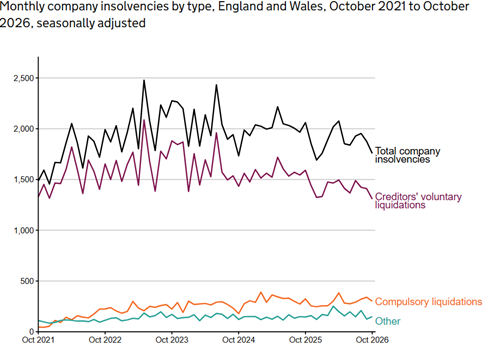
The latest insolvency statistics for October 2026 show a continued decline in Creditors’ Voluntary Liquidations (CVLs) and compulsory liquidations, although administrations increased during the month.
Creditors’ Voluntary Liquidations (CVLs) accounted for 74% of all company insolvencies in October. Numbers fell by 7% compared with September 2026 and were 18% lower than October 2025. This was the lowest monthly total since August 2021.
Across the first ten months of 2026, average monthly CVL numbers were 8% lower than in 2025. However, CVLs remain historically high, with the past four years recording the highest annual totals since records began in 1960.
Compulsory liquidations fell by 11% compared with September and were 7% lower than October 2025. The average monthly number so far in 2026 was 3% below the 2025 average.
Despite this decline, compulsory liquidations reached their highest annual level since 2012 last year, following a 15% increase on 2024.
Administrations, by contrast, rose by 28% compared with September and were 5% higher than October 2025.
The average monthly number of administrations during the first ten months of 2026 was 27% higher than in 2025. However, this increase was largely driven by more than 250 connected companies in the real estate sector entering administration between March and August.
What Do These Figures Tell Us?
The latest figures suggest that company insolvency pressures may be easing, particularly among smaller businesses, where CVLs are the most common form of insolvency.
However, the increase in administrations shows that financial difficulties remain, particularly among larger businesses and corporate groups.
While the overall decline in liquidations is encouraging, insolvency levels remain historically elevated, and businesses facing financial difficulties should seek professional advice as early as possible.
What Is The Trend?
It looks like there is a downward trend in insolvencies at the moment. This also might be in part due to the surprising uptick in the GDP figures in the last quarter. UK real GDP grew by 0.7% in Q3 2026 (July–September) compared with Q2 2026, and rose 1.9% year-on-year, according to the Office for National Statistics release on 12 November 2026.
This backs up some signs that insolvency volumes are easing compared with the very high levels seen in recent years. The average monthly number of CVLs during the first seven months of 2026 was 7% lower than the 2025 average, while compulsory liquidations were 6% lower.
More broadly, average monthly company insolvencies during 2026 have been 6% lower than the monthly average recorded over the preceding three years. This has mainly been driven by lower numbers of CVLs.
The wider business environment has not changed significantly. Many companies continue to face pressure from employment costs, energy prices, borrowing costs, weak demand and historic debt.
However, these pressures are not currently translating into a fresh surge in formal insolvencies.
Our experience earlier in 2026 was that HMRC had increased enforcement activity against companies with tax debts that had been allowed to build up over a long period. This included winding-up petitions and greater use of enforcement officers.
Such action can often become the immediate trigger for either a compulsory liquidation or for directors to place a company into creditors’ voluntary liquidation.
For now, the October figures suggest that insolvency levels are in fact falling.