Monthly Insolvency Statistics July 2024

Published on : 20th August, 2024
Insolvency service logo

The July monthly insolvency statistics have been released. Here we provide a summary overview.

Company Insolvencies

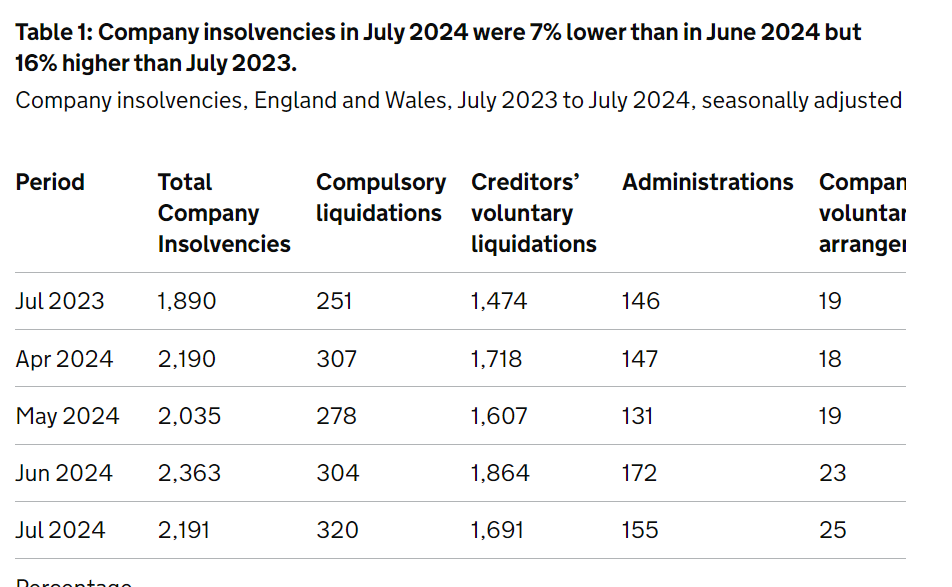
The July 2024 company insolvency statistics for England and Wales showed a total of 2,191 insolvencies, a 16% increase compared to July 2023.

Creditors’ voluntary liquidations (CVLs) remained the most common, comprising 77% of cases.

Compulsory liquidations also saw a rise, reaching their highest level since 2018. Sectors such as construction and retail were notably impacted.

Scotland saw a 21% year-on-year increase in insolvencies, while Northern Ireland’s figures remained stable. The overall trend indicates a gradual increase in insolvency cases across the UK.

Just 25 companies were rescued by using Company Voluntary Arrangements (CVAs) in July.  This is unfortunate as surely it is possible that some of the 1000s of companies that went insolvent last month some might have been able to survive by using a CVA?

CVLs

The number of CVLs decreased by 9% from June 2024 but was 15% higher than during the same month last year (July 2023), after seasonal adjustment.

Compulsory Liquidations

The number of seasonally adjusted compulsory liquidations in July 2024 was the highest monthly number since August 2018, 5% higher than in June 2024 and 27% higher than in July 2023.

In 2023, there were 44% more compulsory liquidations than in 2022, but they were still 4% fewer than in 2019 (before to the pandemic). The numbers have risen from the all-time lows observed in 2020 and 2021, when limitations were placed on the use of winding-up petitions and statutory demands, which resulted in compulsory liquidations.

Administrations

The number of administrations in July 2024 was 10% lower than in June 2024 but 6% higher than in July 2023, after seasonal adjustment.

High profile administrations have been few and far between these last few months with Carpetright being the most noteable exception.
It does seem that In the 12 months to June 2024 compared to the previous 12-month period, insolvencies increased by the most in the hospitality sector.  The increase was c.15%

This is not surprising given that this includes the period of high inflation in the last half of last year.


Written ByRobert Moore

Marketing Manager


+447584583884

Rob has over two decades of experience in web and general marketing. He has extensive knowledge of the Insolvency sector and has helped many worried directors with their questions.

Rob is now working with the Board at RMT to develop strategic marketing programmes to support the business plan and drive more company rescues.

Robert Moore
Insolvency service logo

Monthly Insolvency Statistics: February 2026

in Research and Statistics

In February 2026, there were 1,878 company insolvencies registered in England and Wales. This represents a 7% increase on January 2026, but is 7% lower than February 2025. While this monthly rise may sound concerning, it is worth noting that the increase is less pronounced than usual, with typical month-to-month fluctuations averaging around 10% over the past three years. The rise in February was driven primarily by an increase in Creditors’ Voluntary Liquidations (CVLs), while compulsory liquidations fell slightly compared to January.Longer-term trends Looking at the broader picture, insolvency levels remain elevated by historical standards. Insolvencies last peaked during the 2008–09 financial crisis, before declining through the early 2010s. Numbers rose again in 2018 and 2019, reflecting growing economic pressures. During 2020 and 2021, insolvency activity fell to record lows, largely due to extensive government support measures introduced during the pandemic. From 2022 onwards, insolvency numbers rebounded sharply, with CVLs in particular rising above pre-pandemic levels. By 2023, total insolvencies reached a 30-year high, driven by record levels of voluntary liquidations. In 2025, overall numbers remained high, with an increase in compulsory liquidations offsetting declines in other procedures.Recent slowdown – but still high Encouragingly, the most recent data suggests a modest easing in insolvency volumes. The average monthly number of insolvencies over the last four months was 1,789, which is around 10% lower than the average seen between early 2022 and the end of 2025 (1,982). However, this should be viewed in context. Even with this slight reduction, insolvency levels remain significantly above long-term norms and are still comparable to those seen during periods of economic stress, such as the aftermath of the financial crisis.CVLs In February 2026, CVLs accounted for 78% of all company insolvencies. The number of CVLs increased by 11% from January 2026, but was 3% lower compared to the same month last year (February 2025). The average number of CVLs over the last 4 months was 10% lower than the average monthly number in 2025.In 2025 CVL volumes slightly decreased by 2% from 2024 and by 10% from the record-high number registered in 2023. The past four years have seen the highest four numbers of CVLs since the time series began in 1960. Between 2017 and 2019, CVLs had been rising at approximately 10% per year, but during the COVID-19 pandemic, they fell to their lowest levels since 2007. Compulsory liquidations The number of compulsory liquidations in February 2026 was 2% lower than in January 2026 and 35% lower than in February 2025. Compulsory liquidations in February 2026 were 20% lower than the 2025 monthly average.In 2025, compulsory liquidations were at the highest levels since 2012, having increased by 15% compared to 2024 volumes. This continued an increase from record low levels seen in 2020 and 2021, while restrictions applied to the use of statutory demands and certain winding-up petitions (leading to compulsory liquidations). Administrations The number of administrations in February 2026 was 4% lower than in January 2026, 30% higher than in February 2025, and 17% higher than the 2025 monthly average.In 2025, the number of administrations decreased by 8% from 2024. This followed a sustained increase between 2022 and 2024 after the 18-year annual low seen during the COVID-19 pandemic in 2021.What is causing the changes?The most common creditor in any insolvency is HMRC.  In the last few months, having held back for many years as companies have recovered from the recent headwinds, HMRC is now losing patience with companies that owe tax. What this means for directors The continued prevalence of CVLs highlights a key trend: many directors are choosing to take early, voluntary action rather than waiting for creditor pressure to escalate. If your business is experiencing financial difficulties, acting sooner rather than later can: Increase the range of available rescue options Reduce the risk of personal liability Help preserve value for creditors and stakeholdersIf you are concerned about your company’s financial position, seeking professional advice at an early stage is always the best course of action.

Read
Monthly Insolvency Statistics: February 2026
Insolvency service logo

Monthly Insolvency Statistics: October 2025 Shows Uptick In Compulsory Liquidations

in Research and Statistics

In October 2025, there were 2,029 company insolvencies in England and Wales. The annual number of company insolvencies in the UK for 2024 was 23,872. Individual insolvencies in England and Wales reached 10,552 in October 2025.Company Insolvency Statistics (England and Wales) In October 2025, the number of registered company insolvencies in England and Wales was similar to September 2025 levels but 17% higher than in October 2024. The monthly numbers in the first ten months of 2025 have been slightly higher than in 2024, which followed a 30-year annual high in 2023.The total for October 2025 comprised:1,592 Creditors' Voluntary Liquidations (CVLs) 301 Compulsory Liquidations 119 Administrations 17 Company Voluntary Arrangements (CVAs)In the 12 months ending in October 2025, one in every 187 companies on the effective register entered insolvency. The industries most affected in this period were construction, wholesale and retail trade, and accommodation and food services.Individual Insolvency Statistics (England and Wales) In October 2025, there were 10,552 individual insolvencies, which is a 14% increase compared to October 2024.

Read
Monthly Insolvency Statistics: October 2025 Shows Uptick In Compulsory Liquidations
Insolvency service logo

Government Research Into Creditors Voluntary Liquidations Highlights Virtually Nil Return to Creditors

in Research and Statistics

The Insolvency Service has just released its Creditors’ Voluntary Liquidation (CVL) Research Report.  The purpose of this report was to ascertain whether the recent reforms in 2017 on the CVL process had, in fact, made the process more efficient and increased the returns to creditors.Analysis was performed on a randomly sampled dataset of 2,717 completed CVLs which started in 2017.Efficiency was assessed through three quantitative measures: time to complete the CVL, associated costs, and recovery rates for creditors.Time: 6% of the sampled cases were ongoing at the time of data collection. The median duration to complete a CVL was 712 days.Cost: The median cost, represented as fees relative to the estate's value, was 163%.Recovery Rate: The median recovery rate for all creditors was 0%, indicating that in many cases, creditors did not receive any return.One might ask why the median was used, as opposed to the mean, in these calculations.  This is mainly because in the random sample there may well be some very large company liquidations that would distort the statistics.Other interesting statistics that come out of the research are as followsMedian Pre appointment fees were £4000 see the chart below that shows total fees. The overall returns to creditors are very poor.  The charts below shows preferential creditors that in most cases will be employees and HMRC (post 2020) and Fixed charge creditors who are in fact the first in line showing virtually nil return​ ​This poor level of return is concerning as one of the liquidator's jobs is to try and liquidate the assets to repay creditors.  However, remember the company in question has gone into liquidation as it is unable to pay its creditors!  Most directors will try and put off the inevitable and borrow against any assets they may have or sell them before they enter liquidation.  The reality is that most companies do not have any liquid assets that can be easily sold to repay creditors.  Often assets of any value are costly to move or have a limited market value.  In addition, the liquidators have to do an investigation into the directors conduct to see if they should be disqualified. In addition, in the name of transparency, they have a duty to keep the creditors informed of the reasons for failure, and why they are not going to get any return.So, if CVLs offer such low returns to creditors there should be an alternative process that insolvency practitioners should be using and directors should be made aware of!Administrations are costly and mainly for larger businesses.  The alternative is of course the use of more informal deals with creditors such as Time to Pay Arrangements (TTPs) and the use of the Company Voluntary Arrangement (CVAs) insolvency rescue mechanism.  These are harder to implement than simply advising the company to liquidate and of course there must be an underlying profitable business there.  But surely there are companies out there that could pay off some of the debts over a time period of say, 3-5 years.  Even if the CVA or TTP lasts only a year or two it is signicantly better than a CVL that on this research gives Nil return to any creditor!  Remember a CVA doesn't even bind the fixed charge (secured creditor).The number of TTPs are not really recorded as there is no formal insolvency but the number of CVAs are and it is very low at some 15 or 20 a month.As a small firm that does the second highest number of CVAs, after Begbies Traynor who are the largest insolvency firm in the UK, we believe they are ridiculously underused.However using CVAs KSA Group has;Distributed £31m to creditors 2009-2022. This excludes secured debts and secured factoring facilities, much of which have been or will be repaid. Repaid £17.9m to HMRC between 2009 and 2023, remember this for the most part when HMRC was an unsecured creditor (2009-2020). That’s taxpayers money. Saved creditors money. Preserved 320 customers for thousands for suppliers, accountants and professional advisors.Ultimately, the main thing that should come out of this research is that Directors should act early and not bury their heads in the sand.  Also insolvency pratitioners should not be afraid of exploring other options for distressed businesses such as TTPs or CVAs.

Read
Government Research Into Creditors Voluntary Liquidations Highlights Virtually Nil Return to Creditors