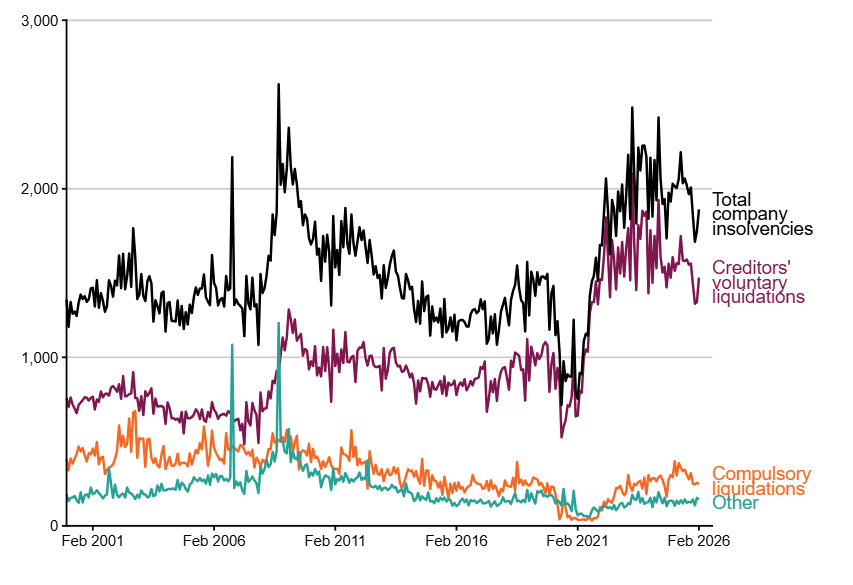
In February 2026, there were 1,878 company insolvencies registered in England and Wales. This represents a 7% increase on January 2026, but is 7% lower than February 2025.
While this monthly rise may sound concerning, it is worth noting that the increase is less pronounced than usual, with typical month-to-month fluctuations averaging around 10% over the past three years. The rise in February was driven primarily by an increase in Creditors’ Voluntary Liquidations (CVLs), while compulsory liquidations fell slightly compared to January.
Longer-term trends
Looking at the broader picture, insolvency levels remain elevated by historical standards.
-
Insolvencies last peaked during the 2008–09 financial crisis, before declining through the early 2010s.
-
Numbers rose again in 2018 and 2019, reflecting growing economic pressures.
-
During 2020 and 2021, insolvency activity fell to record lows, largely due to extensive government support measures introduced during the pandemic.
-
From 2022 onwards, insolvency numbers rebounded sharply, with CVLs in particular rising above pre-pandemic levels.
-
By 2023, total insolvencies reached a 30-year high, driven by record levels of voluntary liquidations.
-
In 2025, overall numbers remained high, with an increase in compulsory liquidations offsetting declines in other procedures.
Recent slowdown – but still high
Encouragingly, the most recent data suggests a modest easing in insolvency volumes.
The average monthly number of insolvencies over the last four months was 1,789, which is around 10% lower than the average seen between early 2022 and the end of 2025 (1,982).
However, this should be viewed in context. Even with this slight reduction, insolvency levels remain significantly above long-term norms and are still comparable to those seen during periods of economic stress, such as the aftermath of the financial crisis.
CVLs
In February 2026, CVLs accounted for 78% of all company insolvencies. The number of CVLs increased by 11% from January 2026, but was 3% lower compared to the same month last year (February 2025). The average number of CVLs over the last 4 months was 10% lower than the average monthly number in 2025.
In 2025 CVL volumes slightly decreased by 2% from 2024 and by 10% from the record-high number registered in 2023. The past four years have seen the highest four numbers of CVLs since the time series began in 1960. Between 2017 and 2019, CVLs had been rising at approximately 10% per year, but during the COVID-19 pandemic, they fell to their lowest levels since 2007.
Compulsory liquidations
The number of compulsory liquidations in February 2026 was 2% lower than in January 2026 and 35% lower than in February 2025. Compulsory liquidations in February 2026 were 20% lower than the 2025 monthly average.
In 2025, compulsory liquidations were at the highest levels since 2012, having increased by 15% compared to 2024 volumes. This continued an increase from record low levels seen in 2020 and 2021, while restrictions applied to the use of statutory demands and certain winding-up petitions (leading to compulsory liquidations).
Administrations
The number of administrations in February 2026 was 4% lower than in January 2026, 30% higher than in February 2025, and 17% higher than the 2025 monthly average.
In 2025, the number of administrations decreased by 8% from 2024. This followed a sustained increase between 2022 and 2024 after the 18-year annual low seen during the COVID-19 pandemic in 2021.
What is causing the changes?
The most common creditor in any insolvency is HMRC. In the last few months, having held back for many years as companies have recovered from the recent headwinds, HMRC is now losing patience with companies that owe tax.
What this means for directors
The continued prevalence of CVLs highlights a key trend: many directors are choosing to take early, voluntary action rather than waiting for creditor pressure to escalate.
If your business is experiencing financial difficulties, acting sooner rather than later can:
-
Increase the range of available rescue options
-
Reduce the risk of personal liability
-
Help preserve value for creditors and stakeholders
If you are concerned about your company’s financial position, seeking professional advice at an early stage is always the best course of action.